Berlin Property Prices and District Guide
What do you have to consider when buying an apartment in Berlin? Our guide answers the most important questions.Updated on 19 May 2025

Table of Contents
- Does buying an apartment in Berlin make sense?
- Property prices in Berlin
- Finding an apartment in Berlin
- Buying an apartment in Berlin
- Purchase fees in Berlin
- Necessary documents for buying a property in Berlin
- Property prices by districts of Berlin
- Property prices in Berlin-Mitte
- Property prices in Friedrichshain-Kreuzberg
- Property prices in Neukölln
- Property prices in Tempelhof or Schöneberg
- Property prices in Charlottenburg or Wilmersdorf
- Property prices in Steglitz and Zehlendorf
- Property prices in Spandau
- Property prices in Reinickendorf
- Property prices in Pankow
- Property prices in Lichtenberg
- Property prices in Marzahn-Hellersdorf
- Property prices in Treptow-Köpenick
- Rental returns in Berlin
- Real estate trends in Berlin
- Does buying an apartment in Berlin make sense?
- Property prices in Berlin
- Finding an apartment in Berlin
- Buying an apartment in Berlin
- Purchase fees in Berlin
- Necessary documents for buying a property in Berlin
- Property prices by districts of Berlin
- Property prices in Berlin-Mitte
- Property prices in Friedrichshain-Kreuzberg
- Property prices in Neukölln
- Property prices in Tempelhof or Schöneberg
- Property prices in Charlottenburg or Wilmersdorf
- Property prices in Steglitz and Zehlendorf
- Property prices in Spandau
- Property prices in Reinickendorf
- Property prices in Pankow
- Property prices in Lichtenberg
- Property prices in Marzahn-Hellersdorf
- Property prices in Treptow-Köpenick
- Rental returns in Berlin
- Real estate trends in Berlin
Our guide shows you what you need to know about buying an apartment in Berlin and gives you an overview of the local property prices per neighborhood.
Does buying an apartment in Berlin make sense?
Does buying in Berlin still make sense? According to the latest edition of the Housing Cost Report 2022, it still does. The report shows that almost everywhere in Germany, it remains cheaper to buy a property and live in it yourself than to rent a similar flat or house yourself. This even applies to the German metropolises, where purchase prices have risen significantly in recent years.
In the capital city of Berlin, owner-occupied housing costs around 47% less than renting. This is a great potential saving — especially in the long term. It is remarkable that this advantage for owner-occupied housing has hardly changed despite the end of the low-interest period. In Berlin, the advantage has even increased in the past two years. This is mainly due to the significant increase in rental prices.
Calculate your mortgage options
Use Hypofriend’s mortgage calculator to calculate your mortgage options in Germany.
Property prices in Berlin
The purchase prices for apartments in Berlin have risen dramatically in recent years. At times, no other city in the world has seen prices rise as sharply as Berlin. Strong population growth, a stable economic situation, and a high interest of foreign investors were the reasons for this.
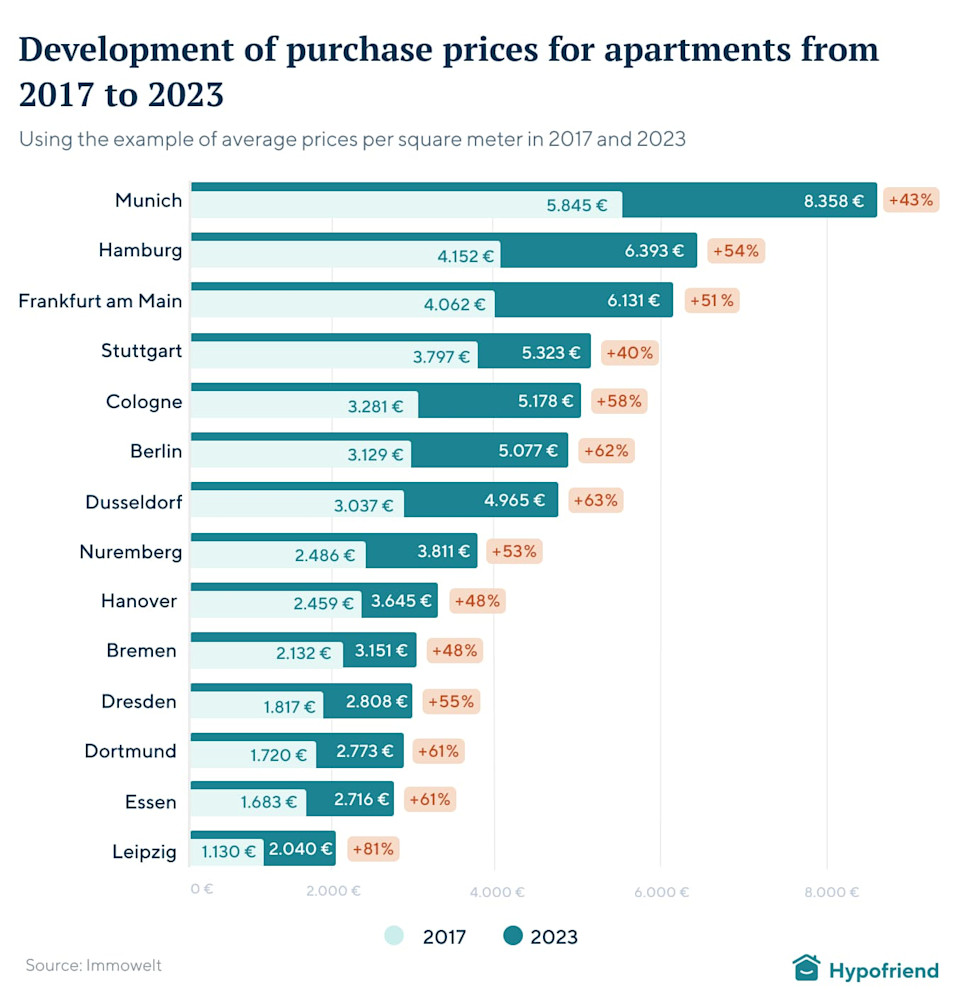
According to Immowelt, purchase prices for apartments in Berlin have risen by 62% in the past 5 years alone. In 2022, a square meter in Berlin cost a median of 5.077 €, whereas in 2017, prices were still favorable, 3.129 € per square meter.
The purchase price development sounds extreme. It is, but Berlin came from a very low level. For example, the 2010 square meter price of 1.430 € was exceptionally low for a major capital city. With a median square meter price of 5.077 €, the costs are still moderate. By comparison, In Munich, the median price per square meter in 2022 was 8.994 €, and in 2010, it was already just under 3.000 €. Let alone Paris or London.
In Berlin, there is still an upward potential. Dr. Chris Mulder writes that German property prices are historically undervalued.
“With the onset of the Corona crisis, some expected property prices to fall, but this did not happen. Even in the wake of the current high inflation and impending recession, there were renewed threats that a supposed “real estate bubble” would burst. It is true that property prices have fallen in some cities and regions in recent months, but only by low single-digit percentages. There is no question of a bubble bursting; at best, it is a slight correction. It remains true that real estate is a stable investment, especially in times of volatile markets, and the current uncertainties have caused many people in Germany to reconsider their housing situation. Berlin's real estate market is also unique in Germany. The demand for apartments and houses for sale in Berlin is almost unbroken. This is confirmed by Guthmann Estate's market report: “However, as the largest property market in Germany, Berlin tends to behave anti-cyclically and, in addition to the high concentration of supply and demand, benefits from the capital city bonus and the overall very international character of the property market.”
The demand for real estate exceeds the supply. This is likely to continue to drive up property prices in Berlin in the future. One indicator of this is the vacancy rate for apartments, which is extremely low in Berlin. The latest data show a vacancy rate in Berlin of just 0,9 % in 2022. By comparison, the vacancy rate in 2003 was still 5.1 percent. This clearly shows the high level of immigration, and thus, the demand for residential properties in Berlin remains consistently high. The national average vacancy rate currently stands at 2.8 percent.
Property prices in Berlin have been rising for years. This is due to the factors already mentioned. Anyone who wants to buy a property in Berlin must spend a median of 5.480 € per square meter for an existing property in early 2023. For new buildings, the price is significantly higher at 8.540 € per square meter. This is shown by data from Guthmann Estate.
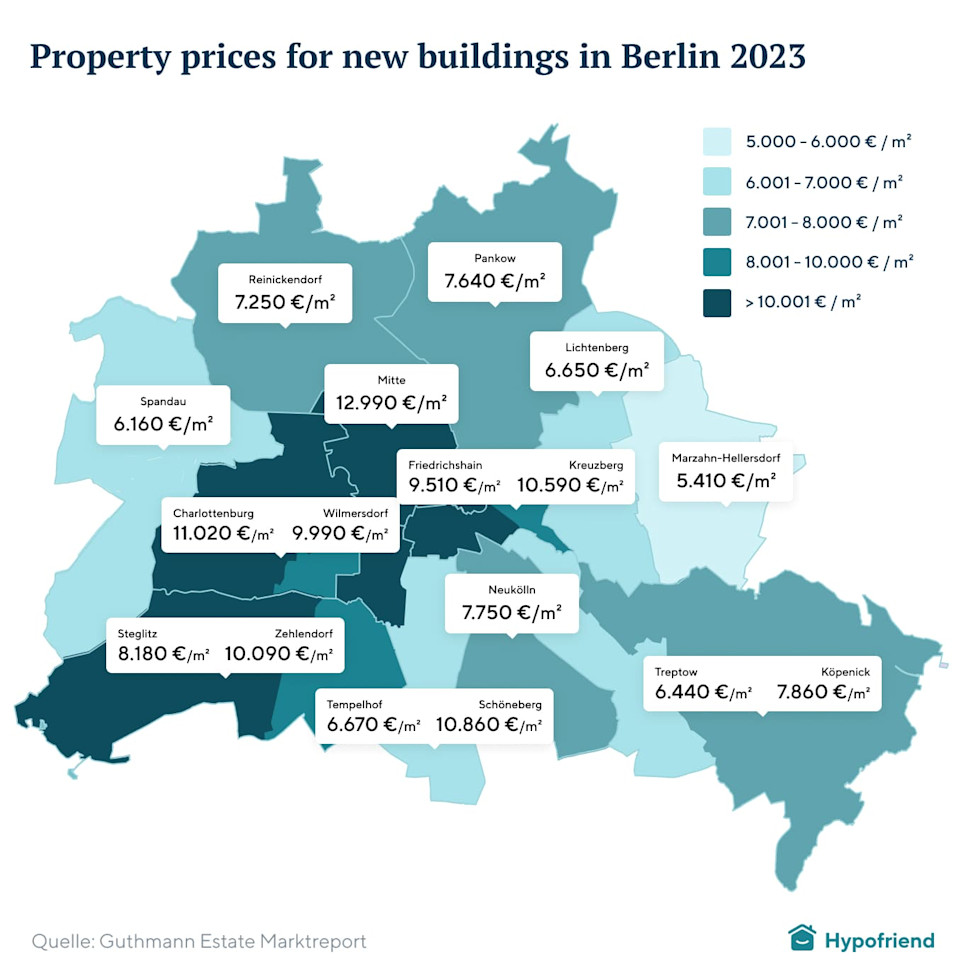
Depending on the district, property prices vary greatly. In Berlin-Mitte, for example, the median price of a new-build apartment in February 2023 was more than 12.990 € per square meter. In Spandau, the median price of a new-build square meter in the same period was just 6.160 €. That is less than half of what it is in Berlin-Mitte!
Finding an apartment in Berlin
If you are specifically looking for an apartment in Berlin, the major real estate portals will help you. The best thing to do first is to sign up for Hypofriend to see what you can afford.
Once you know how much you can afford, you can start looking for your dream apartment. Our weekly property alerts will help you find properties based on your search criteria: how large your desired property should be, how much it should cost, and where it should be located. If a new property that meets your search criteria comes onto the market, you will receive a notification. This way, you don't miss anything and stay up to date.
You should also fill out your profile on the property portals and keep it up to date. This will give sellers and real estate agents a good impression of you and your financial situation.
However, many properties do not even make it onto the official market. Because especially good offers are quickly placed under the table. Real estate agents often already have several potential buyers on hand for new properties. Therefore, it makes sense to introduce yourself to real estate agents in the desired area and leave your search criteria for properties for sale.
In this guide, we've put together tips on how to find a property in Germany.
Buying an apartment in Berlin
If your purchase project is concrete, your next step in the process of buying is the search you should look for an optimal mortgage in Berlin. It's important to know that you will not necessarily get the best offer from your bank. That is why a comparison of mortgages is always worthwhile.
After all, a mortgage can have a significant impact on your financial future. Accordingly, your financing should be tailor-made for you. With the wrong product, you can quickly lose several thousand euros.
Having a mortgage broker in Berlin can also increase the chances of actually winning the bid for your dream property. The financing certificate that you get from Hypofriend shows the landlord or agent that you are capable of paying the marketed purchase price.
Purchase fees in Berlin
Anyone buying an apartment in Berlin shouldn't ignore the additional costs of the purchase. In addition to the property price, there are other fees for the notary, land registry, property transfer tax, and the real estate agent. The amount of these costs varies from state to state.
Buyers in Berlin and Brandenburg have to dig deep into their pockets. The purchase fees in Berlin amount to an average of 11,57 % of the purchase price. The expenses are made up as follows:
Property transfer tax: 6%
Notary and land registry entry: 2%
Real estate commission: 3,57 %
Tip: Many newly built apartments are sold without a real estate agent and require just 8 percent purchase fees, but beware of the uptick in the prices as some developers build the fees into the price.
Use our purchasing costs calculator to determine the exact purchasing costs for your dream home.
Necessary documents for buying a property in Berlin
To apply for a mortgage in Berlin, you must prepare several documents. These include personal documents as well as documents about the property you want to buy.
In our guide “Which documents do you need when you apply for a German mortgage?” we have listed all the important documents you need. We also explain which additional documents you need if you are self-employed or want to buy a newly built property.
Property prices by districts of Berlin
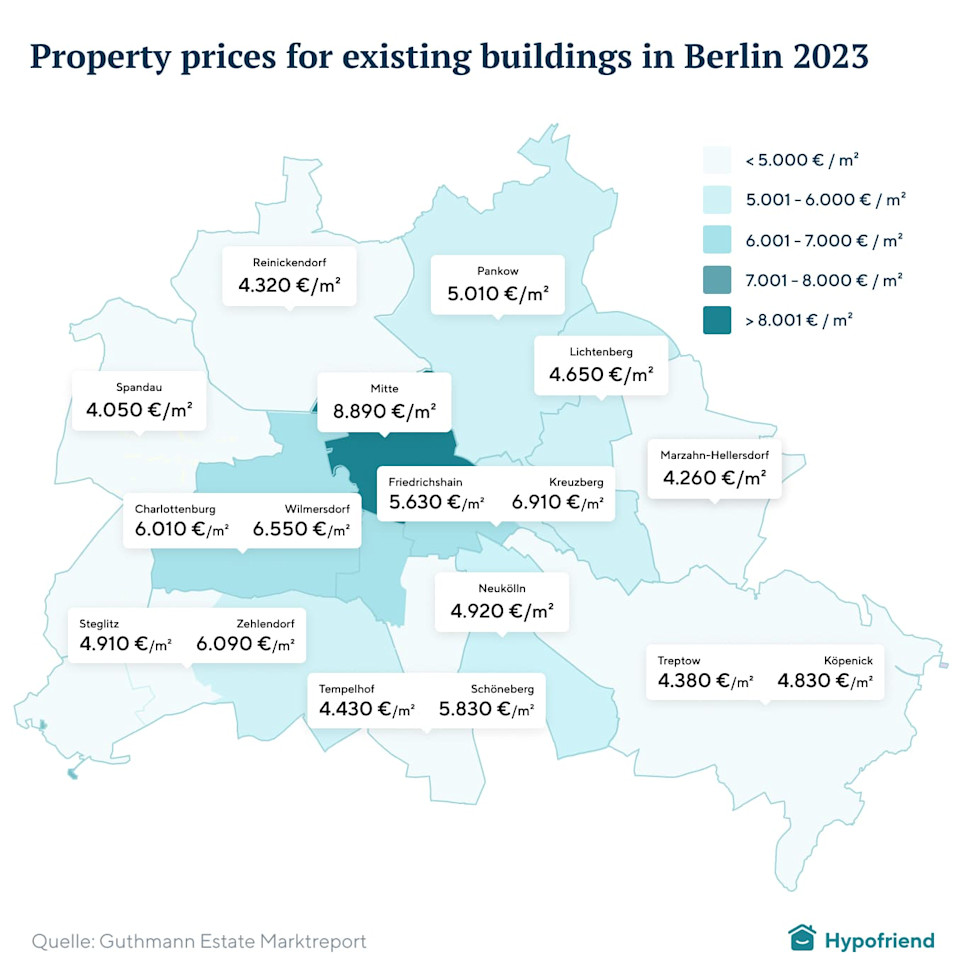
The purchase prices for apartments in the capital of Germany vary greatly from district to district. In the following section, we will give you an overview of the districts with the median current purchase prices for existing and new buildings. The prices for this come from Guthmann Estate.
Property prices in Berlin-Mitte
For an existing property in Berlin's trendy Mitte district, you have to spend a median of 8.890 € per square meter for an existing apartment. A new build costs 12.990 € more per square meter.
Those who live in Mitte live in the pulse of the city. In Mitte, there are also many tourists. Brandenburger Tor, Checkpoint Charlie, or the Wall Memorial — many of Berlin's top sights are located in Mitte. Thanks to Museum Island, there is also plenty of culture to offer.
The Friedrichstraße, the Hackescher Markt, or the Potsdamer Platz invite you to go shopping. On Torstraße, one restaurant follows the other. Many companies also have their headquarters in Mitte. The district is especially popular among young people, and employees don't have a long commute to their offices.
Property prices in Friedrichshain-Kreuzberg
An apartment in the Friedrichshain-Kreuzberg district costs, on average, between 5,200 and 6,520 euros per square meter. New buildings are considerably more expensive: Buyers can expect to pay between 8,810 euros and 9,920 euros per square meter.
Both Friedrichshain and Kreuzberg attract free spirits. Here, everyone can live as they want to. The population is accordingly colorful, international, and alternative. The Volkspark Friedrichshain, the park at Gleisdreieck, many restaurants, and the most famous clubs in Europe are located here.
An addition is its beautiful location close to the Spree. This makes Friedrichshain-Kreuzberg very popular with families and young people alike. Especially in the last few years, the district has become very popular.
Property prices in Neukölln
and Property prices in Neukölln are still lower than in other inner-city districts. A square meter costs about 4.920€, and for new buildings, it costs 7.750€.
Neukölln is particularly popular among young people because of the lower rents. On Weserstraße, one bar follows another and attracts Berliners from all areas of the city. Neukölln is also characterized by its internationalism. There is hardly any other district where you will find so many nationalities. Nowhere else in Berlin is multiculturalism so strongly lived.
Although Neukölln is not known for its green spaces, the Tempelhofer Feld and the park in the Hasenheide offer a green retreat.
Property prices in Tempelhof or Schöneberg
If you want to buy an existing property in Tempelhof or Schöneberg, you have to spend an average of 4.430 € per square meter in Tempelhof and 5.830 € in Schöneberg. A new building is considerably more expensive at 6.760 € or even 10.860 € in Schöneberg. The district is characterized by its versatility and serenity. Due to its proximity to Charlottenburg, Schöneberg has many classic cafés and restaurants that are elegant but not out of place. Schöneberg also has a popular LGBTQIA+ community.
The Tempelhofer Feld, which was an airport in the past, is nowadays a huge park that is unique because of its runway. In Tempelhof, real estate prices are moderate, which is why many families move here.
Property prices in Charlottenburg or Wilmersdorf
Charlottenburg and Wilmersdorf are among the most expensive residential areas in Berlin. Buyers have to pay an average of 6.010 € per square meter for a refurbished old building in Charlottenburg and 6.550 € in Wilmersdorf. A square meter of new construction is even 11.020 € and 9.990 € per square meter, respectively.
Charlottenburg and Wilmersdorf are part of classic West Berlin and are enchanted by their magnificent old buildings and promenades. Kurfürstendamm is one of the most famous shopping streets in Germany and home to the shops of all the great designers. Charlottenburg and Wilmersdorf are trendy not only when shopping but also when it comes to restaurants and cafés. A contrast to the bohemian places is Kantstraße, which is famous for restaurants with Asian cuisine.
Charlottenburg-Wilmersdorf also has plenty of culture to offer. The German Opera and Schloss Charlottenburg are also worth a visit.
Property prices in Steglitz and Zehlendorf
Also in the west is the district of Steglitz-Zehlendorf. Here, the average price per square meter for an existing flat is 4.910 € in Steglitz and 6.090 € in Zehlendorf. For a new build, the prices per square meter are correspondingly higher: 8.180 € and 10.090 €, respectively.
Both in Steglitz and Zehlendorf, the quality of life is a top priority. Zehlendorf is known for its grand old villas and magnificent single-family homes. Steglitz feels like a small town in a big city. In the Schloßstraße are shops for everyday needs.
Wannsee itself, as well as the Große and Kleine Wannsee, are also part of Steglitz and Zehlendorf and attract water sports enthusiasts. Nevertheless, Ku'Damm can be reached by a short car or train ride.
Property prices in Spandau
Spandau is one of the less expensive districts in Berlin. An existing property here costs an average of 4.050 €, and a new building about 6.160 €.
Spandau is located in the west of Berlin and borders Wilmersdorf, Steglitz, and Reinickendorf. It is characterized by a quiet and familiar atmosphere. Spandau has the largest area with the smallest number of inhabitants and, accordingly, many green spaces and retreats. Nevertheless, the city center is only a 15-minute train ride away.
Property prices in Reinickendorf
Reinickendorf is located northwest of Berlin. Real estate buyers have to pay here 4.320 € per square meter for a renovated old building and 7.250 € per square meter for a new building.
In Reinickendorf, things are done with care, and it seems almost village-like in contrast to the big city. Reinickendorf does not have great nightlife or a lot of entertainment, and nature is not exuberant either.
On the other hand, the district benefits from its proximity to Berlin and is particularly popular with commuters. Work in the hustle and bustle and live in peace. The property prices in Reinickendorf are correspondingly moderate.
Property prices in Pankow
The price per square meter for an existing property in Pankow is a median of 5.010 €. A new building costs 7.640 €. This is because hardly any new buildings are being built in the trendy quarter of Prenzlauer Berg due to lack of space. The existing properties are being renovated. If you want to live in a new building, you have to move out a little further.
Pankow is the second-largest district in Berlin and is very popular. The district Prenzlauer Berg in the south attracts residents as well as tourists. Beautiful old buildings, hip cafés, bars, and cute shops characterize the streets there.
Pankow stands out as a great place for families. It is clean, you meet many parents, and towards Weißensee, there is a lot of nature. Pankow is popular, which is also reflected in the higher property prices.
Property prices in Lichtenberg
Those who are looking for properties in the northeast of Berlin pay 4.650 € per square meter in Lichtenberg and 6.650 € for a new building.
Lichtenberg is located in the former East Berlin. The location is often considered ideal because Lichtenberg is close to the turbulent city center and yet quiet and greener. If you are looking for entertainment, take the train. If you need relaxation, take a bike ride to the Spree at the Rummelsburger Bucht. This combination has made Lichtenberg more popular and dynamic in recent years.
Originally, Lichtenberg was considered a working-class district. There is still a lot of potential and development opportunities in the district.
Property prices in Marzahn-Hellersdorf
In Marzahn-Hellersdorf, the real estate prices are among the lowest in Berlin. The square meter costs here 4.260 € and 5.410 € for a new building.
“The district of Marzahn-Hellersdorf has a rather negative reputation. It is often associated with Plattenbau and gray in gray. However, what was true after the fall of the Berlin Wall is currently changing. Many families are moving out of the city to Marzahn or Hellersdorf. The old “Platten” are being modernized, made friendlier, and offer a great view.
The low rental and purchase prices and green spaces are also an advantage. Due to the strong population growth in Berlin, Marzahn-Hellersdorf will also see some changes in the next few years.
Property prices in Treptow-Köpenick
The districts of Treptow and Köpenick are green oases in the southeast of Berlin. Potential buyers here have to expect an average of 4.380 € in Treptow and 4.830 € in Köpenick for a refurbished old building. A new building costs 6.440 € and 7.860 € per square meter, respectively.
Treptow-Köpenick offers its residents of all districts the largest proportion of forest and water bodies. Köpenick itself has a picturesque old town from the 12th century with countless cafés and restaurants. The quality of life is particularly high in the district.
Treptow-Köpenick is gaining importance as a business location. Not least because of this, many young people have moved to Treptow-Köpenick in the past five years.
Rental returns in Berlin
The property does not necessarily have to be lived in by the owner. It is also worth renting it out. This makes sense, especially in cities like Berlin, which have strong population growth and a low vacancy rate. Another advantage is the currently low mortgage interest rates. A mortgage has rarely been cheaper.
Tip: Read our deep dive guide “Why Buy-to-Let is so attractive in Germany.” In Berlin, owners achieved an average rental yield of 3,33 % in 2022.
However, if you buy a rented apartment in Berlin, there is one point to consider: Berlin strongly protects its tenants. Especially, people who have been living in a property for a long time cannot easily be evicted by the new owner. In Berlin, tenants have ten years of protection. This means that the new owner can only register the apartment after ten years at the earliest — other procedures like claiming own use are not recommended.
Tenants who have lived in a property for a long time pay very little rent. Only sometimes cash offers are negotiated for tenants in case of early termination. That makes the investment uninteresting. Buying properties in Berlin makes a lot more sense for own use, as can be seen in our Rent-or-Buy calculator.
Real estate trends in Berlin
According to Guthmann Estate, Berlin currently lacks more than 106.000 apartments. The calculation considers the difference between the number of inhabitants and the statistical household size minus the housing stock.
Berlin has been lacking housing for years. In the first half of 2022, Berlin again issued fewer building permits than in the previous year. According to the Berlin-Brandenburg Statistics Office, 8.276 approved flats were reported for the period. That is 9,5 % less than in the same period last year. According to the office, the negative trend in residential construction has been continuing for four years. In addition, the influx has increased enormously.
The demand for real estate in Berlin will, therefore, remain high in the foreseeable future, and the supply of properties for sale will remain scarce. Interest from national and international buyers continues. Added to this are the good conditions for mortgages in Berlin, which make buying a flat even more attractive.