
German population projections
Demographic projections seem to validate this tsunami fear because of Germany's low birth rate. Over the last 50 years, immigration has more than offset this. This is not a recent trend. Looking back, Germany has attracted immigrants throughout most of its history, with its population tripling in the 19th century. Going forward, the Destatis (Federal Statistical Office of Germany) 15th Coordinated Population Projection shows, though, that population could decline:
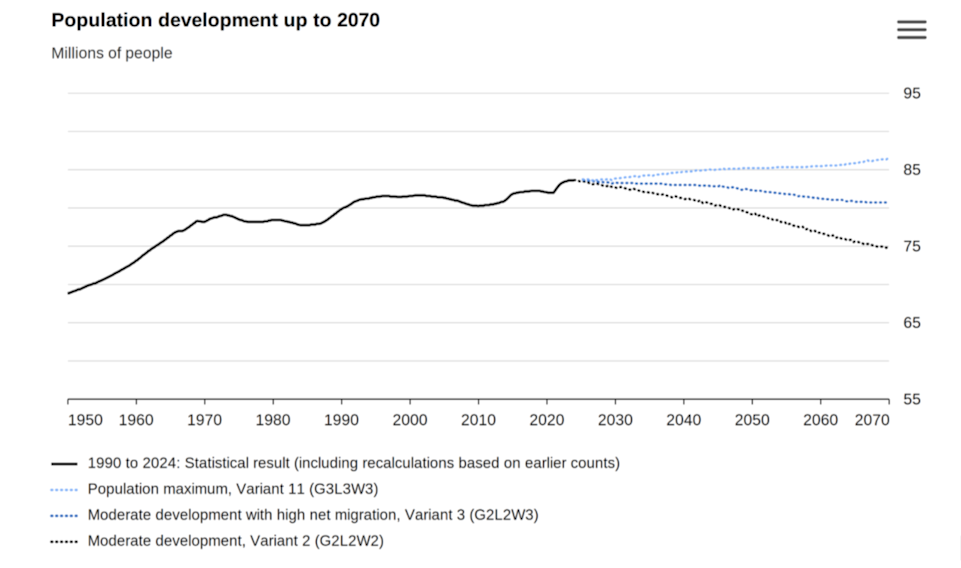
When immigration is high, and birth rates return to the 2015-2021 level, the population keeps increasing. In a scenario with medium birth rates, medium life expectancy, and medium migration, the population size decreases slightly. But with low migration and birth rates at about the current level the population would decline to 1970 levels.
Household growth vs. population headcount: what truly drives housing demand?
However, population growth isn’t the only key driver of the housing market.
Household density has been declining for years. This is driven in part by an ageing population, where the surviving partner stays in the home, smaller family sizes linked to low birth rates, and by people being able to afford to live by themselves. Over the past 25 years, household density has declined steadily by about 0,31 % per year. In total numbers: while the German population grew by just 2 % over the past 25 years, the total number of households, and hence housing demand, grew by 10 %.
25-year household growth scenarios
The following graph shows the development of total housing units over the past 25 years and over the next 25 years, based on the three population projections discussed above.
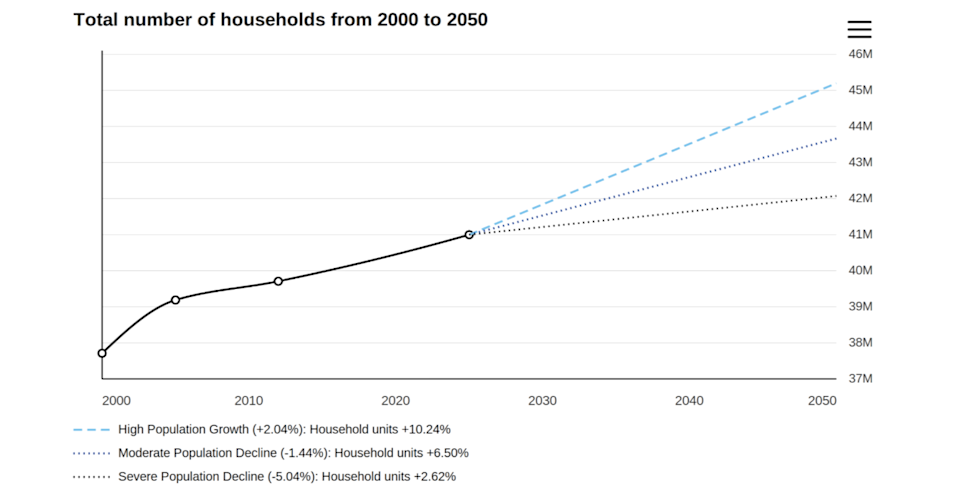
Housing demand is driven by household units, not total people. We evaluated three 25-year demographic scenarios: a slight increase (+2.04%), moderate contraction (-1.44%), and severe contraction (-5.04%). In every scenario, even with a 5.04% population drop, housing demand will likely continue to rise.
Across all of these scenarios, the number of households grows - even when population size decreases. This naturally increases demand.
Yes, there are scenarios where this isn’t true - but they are also very unlikely. For this to be probable, it would need even lower birth rates and/or low immigration. The latter is especially unlikely, as a population decline creates strong incentives for immigration, as workers are needed, among other things, to care for the elderly.
Is the size of the housing units declining?
The above shows that the number of units is increasing, but if per-person demand for M2 were to decline and large houses were split into smaller units, this might still reduce overall housing demand. The opposite is actually true. Demand for m2 has been increasing, resulting in larger units. This increase in unit size has occurred even though there are fewer people per unit. The average housing size was 84,6 M2 in 2000. This has increased to 95,0 M2 in 2025. This is an annual trend of 0,42% annually. This is even more significant than the household unit trend. This trend, driven by rising income and wealth, would add almost 5% to housing demand over 10 years if all existing units were merged and then split into larger units! This trend alone outweighs the population decline.
Will the silver tsunami cause housing oversupply in Germany?
The silver tsunami is therefore unlikely to trigger the housing collapse many have proclaimed. Some Boomer-owned properties will enter the market, others will be inherited, and occupied by children and grandchildren. Overall, the structural shifts toward smaller, more numerous households will absorb inventory, keeping total net housing demand positive for decades to come. In addition, builders need to build larger units, or merge smaller units into larger ones, to meet demand for more sizable units. This will add substantially to the housing demand.